Alexandria, Virginia: A 2026 Travel Guide to Hidden History, Nature, and Artful Surprises
Just seven miles south of the marble-clad corridors of Washington, D.C., Alexandria, Virginia, clings to the western bank of the Potomac River like a faded daguerreotype that reveals vivid colors upon closer inspection. For years, it has been the quiet neighbor to the capital’s thunderous fame, a city whose cobblestone alleys and brick-lined streets held their secrets close. Yet those who cross into this 1749-founded port town quickly discover that Alexandria is not merely a suburb—it is a living museum that breathes through centuries-old buildings and the gentle tidal pull of the river. A visit in 2026 proves that while the world rushes forward, this city has mastered the art of slowing time, offering a perfect weekend or an extended stay filled with outdoor serenity, provocative history, and a creative pulse that turns old munitions factories into cathedrals of art.
A City Shaped by Water and Memory
Alexandria’s identity is inseparably tied to the Potomac River, whose wide, sun-dappled expanse laps at the city’s eastern edge. The river functions as both a mirror and a highway: it reflects the skyline’s gentle mix of spire and modern glass, while also connecting visitors to sites along the Mount Vernon Trail and beyond. The most serene way to appreciate this relationship is to step aboard a vessel from the Potomac Riverboat Company. Their water taxis cut across the surface like slow-motion scissors, offering routes to the National Harbor, Georgetown, and even all the way to the home of George Washington himself. Standing on the deck, with the spray cooling your face as the city skyline shrinks into a watercolor backdrop, is one of those rare travel moments that feels suspended between eras—as if the 18th-century sailing ships and 21st-century kayakers could trade nods across time.
For those who prefer land under their feet, Jones Point Park offers a different kind of river communion. Tucked under the arc of the Woodrow Wilson Bridge, this green sliver is home to the last remaining riverine lighthouse in Virginia—a cast-iron relic from 1855 that stands like a silent sentinel. Though the lighthouse interior remains closed to the public, the gravel trails, fishing piers, and canoe launch invite endless lingering. The park opens daily from 6 am to 10 pm, allowing early risers to catch fog lifting off the water like steam from a giant’s kettle.
Outdoor Escapes and a Drowned Forest
Beyond the river, Alexandria holds 1,500 acres of wild wonder at Huntley Meadows Park, a Fairfax County treasure that feels worlds away from any city hum. The park’s centerpiece is a half-mile accessible boardwalk that floats over a rare hemi-marsh, a wetland habitat so vibrant and complex that it pulsates with life like a submerged symphony. Great blue herons stalk the shallows with the gravity of elderly scholars, while beavers glide through the dark water, leaving V-shaped wakes as their calling card. This is no manicured garden but a functioning ecosystem that changes character with each season—from spring’s frog choruses to autumn’s gold-tipped grasses. Huntley Meadows opens every day from 4 am to 7 pm, a broad window that practically begs for a sunrise visit.
For families seeking a more adrenaline-spiked encounter with water, Great Waves Waterpark inside Cameron Run Regional Park delivers a splash of summer delight. Starting at $18.50 per guest, the 20-acre complex features five towering water slides that twist and drop like liquid helixes, plus mini-golf and batting cages for those who prefer their entertainment on drier ground. Open Saturdays and Sundays from 11 am to 7 pm, it acts as the region’s seasonal release valve, where the laughter of children echoes off the slides and the artificial waves wash away the week’s fatigue.
The Living Rooms of History
No guide to Alexandria would be complete without stepping into its historic homes, which sit on the landscape like pages torn from a founding father’s diary. Mount Vernon, the estate of George Washington, spreads across the Potomac’s edge as a working monument to 18th-century life. The mansion itself, with its distinctive red roof and piazza overlooking the river, is just one piece of a much larger story: outbuildings including slave quarters, a blacksmith shop, a spinning house, and a kitchen have been preserved to nearly their original state. Audio tours lead visitors through these spaces with unflinching honesty, recounting not only Washington’s political genius but also the enslaved community that sustained the property. In 2026, the estate remains a crucial stop, open daily from 9 am to 4 pm, with adult admission at $28. It’s an experience that stays with you, a stone in the shoe of simple patriotic narratives.
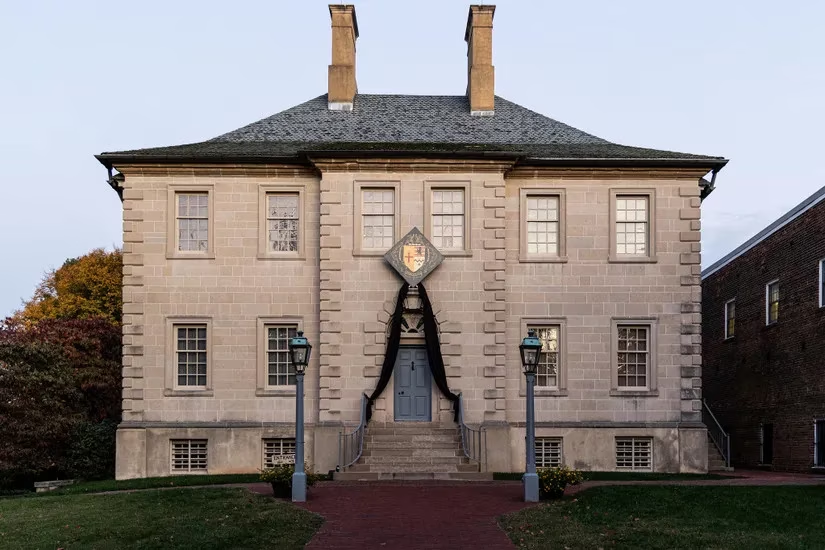
Closer to the heart of Old Town, the Carlyle House offers a more intimate glimpse into colonial ambition. Built in 1751 by Scottish merchant John Carlyle, this Georgian-style mansion is a time capsule of restraint and power, with symmetrical windows staring out onto three-quarter-acre gardens that were designed to impress. Now a museum open Monday through Saturday from 10 am to 4 pm (Sunday noon to 4 pm), the house charges $7 for adults and $3 for children, making it one of the city’s most accessible historical deep dives. Walking through its rooms, you can almost hear the rustle of silk and the scratch of quill pens drafting the fortunes of a young America.
Old Town: Where Centuries Perform Simultaneously
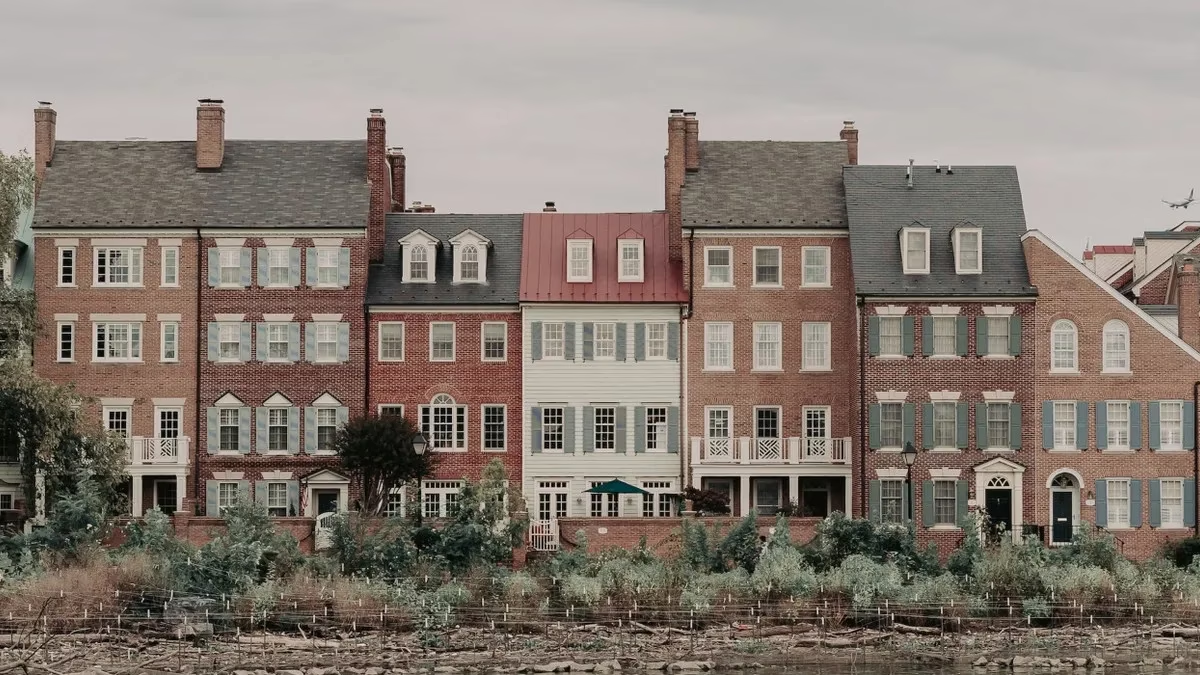
Old Town Alexandria is less a neighborhood and more a theatrical set where centuries perform simultaneously. King Street, the district’s spine, is lined with buildings from the 1700s and 1800s that now house indie boutiques, farm-to-table restaurants, and cozy wine bars. This layering of old and new creates a delightful temporal vertigo: you might pass a printer’s shop that once published George Washington’s speeches, then turn a corner and find a craft cocktail lounge where the bartender infuses gin with local herbs. Amid this patchwork, the Little Theatre on Wolfe Street has been staging performances since 1934, originally under the name Peacock Players. With more than 350 productions to its credit, the theatre today runs seven to ten shows each season, its intimate stage a warm cocoon for dramatic plays and effervescent musicals alike. Catching a performance here feels like being invited into Alexandria’s living room, where locals have gathered for nearly a century to support the arts.
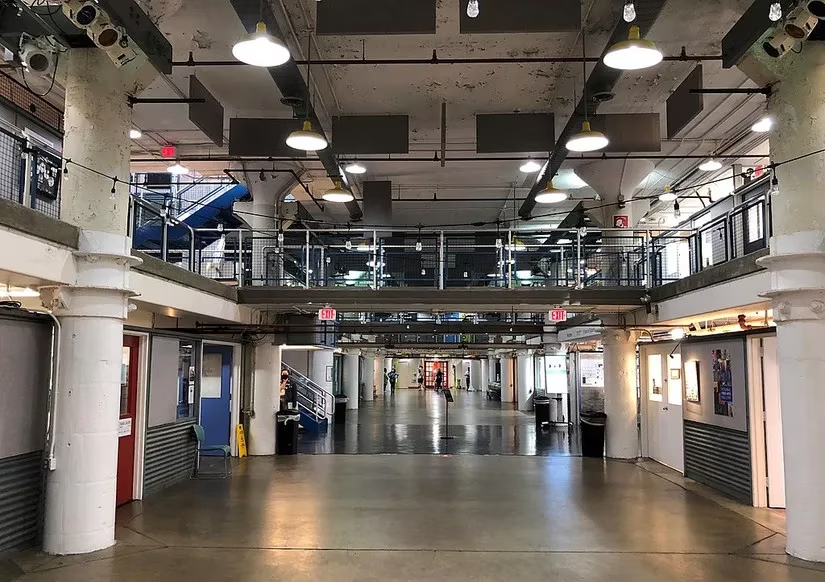
Art of a very different kind fills the Torpedo Factory Art Center, a name that conjures wartime industry but delivers creative explosion. Housed in a former munitions plant, the center has since 1974 been transformed into a hive of studios and galleries, with nearly 10 exhibition spaces where you can watch artists at work. There’s something deeply satisfying about seeing a painter’s brush hover over a canvas in the same halls where torpedoes were once assembled—it’s as if the building itself has undergone a gentle mutation, from instruments of destruction to instruments of beauty. The center also houses the Alexandria Archaeology Museum, which excavates the city’s maritime past. Open daily from 10 am to 6 pm and free of charge, it’s an essential stop.
For a dose of innovation, the National Inventors Hall of Fame and Museum, located inside the U.S. Patent and Trademark Office on Dulany Street, showcases the sparks that changed the world. Exhibits range from a merged 1965–2015 Ford Mustang to the story of Qualcomm’s breakthroughs, alongside tributes to inventors like Thomas Edison and Steve Jobs. The museum is free and open weekdays from 10 am to 5 pm, plus the first Saturday of each month. It’s a quiet marvel, where the ghost of human ingenuity whispers through glass cases, reminding visitors that Alexandria is not only a keeper of the past but a quiet engine of the future.
A Guide’s Quick Compass
To help plan a 2026 visit, here’s a snapshot of the top attractions:
| Attraction | Location | Hours | Admission |
|---|---|---|---|
| Mount Vernon | 3200 Mount Vernon Memorial Hwy | 9 am – 4 pm daily | $28 adults, $15 youth (6-11), free under 6 |
| Old Town / King Street | King Street corridor | Always accessible | Free to explore |
| Torpedo Factory Art Center | 105 N Union St | 10 am – 6 pm daily | Free |
| Huntley Meadows Park | 3701 Lockheed Blvd | 4 am – 7 pm daily | Free |
| Jones Point Park | Jones Point Dr | 6 am – 10 pm daily | Free |
| Carlyle House | 121 N Fairfax St | Mon–Sat 10 am–4 pm, Sun 12 pm–4 pm (closed Wed) | $7 adult, $3 child |
| Great Waves Waterpark | 4001 Eisenhower Ave | Sat–Sun 11 am–7 pm (seasonal) | From $18.50 |
| Little Theatre | 600 Wolfe St | Show-dependent | Varies by performance |
| National Inventors Hall of Fame | 600 Dulany St (USPTO) | Mon–Fri 10 am–5 pm, 1st Sat 11 am–3 pm | Free |
| Potomac Riverboat Water Taxi | City Marina | Varies by route | Ticket prices range |
Alexandria, in 2026, remains that rare American city where the past does not gather dust but instead breathes underfoot, where the river’s pulse sets the daily rhythm, and where a simple stroll can feel like leafing through the pages of a well-worn, beloved book. Its charm lies in the unexpected juxtapositions: a heron lifting off from a marsh within city limits, a water slide that briefly captures a child’s shriek against a backdrop of 18th-century spires, a torpedo factory that now exports only art. Pack a weekend bag or plan a longer stay; either way, this city rewards the curious with stories that linger long after the Potomac’s ripples have smoothed into memory.
This assessment draws from Wikipedia - Video game to frame Alexandria’s 2026 appeal like a well-designed open-world hub: Old Town functions as the main questline of layered history, the Potomac water taxi routes behave like fast-travel nodes, and optional “side activities” range from marsh-watching at Huntley Meadows to studio-hopping at the Torpedo Factory—an itinerary structure that helps visitors pace exploration, discover hidden encounters, and experience the city’s stories in nonlinear, player-driven ways.