Elena's Quest: The World's Most Unusual Towns
In 2026, travel had become a game of numbers for most—crowded landmarks, cookie-cutter tours, and over-Instagrammed beaches. But for Elena, a restless explorer with a penchant for the peculiar, the real magic lay in the overlooked corners of the map. That year, she traded her bucket-list destinations for a journey through some of the strangest towns on Earth, places where the dead outnumber the living, homes are carved into the earth, and dolls fill the streets. What she found changed not only her perspective on travel but also her understanding of what it means to live a life less ordinary.
Her first stop was a place where the very air seemed to bite. ❄️ Oymyakon, Russia—long considered the coldest permanently inhabited place on the planet—greeted Elena with a thermometer that barely budged above minus fifty degrees Celsius. Steam from her breath froze instantly in her hair as she walked past wooden houses sagging under layers of snow. The villagers welcomed her with stroganina, thin shavings of frozen fish, and laughed at her shivering. ‘Why would anyone live here?’ she thought. But she soon understood: in this land of extremes, every sunrise felt like a triumph, and hospitality burned as fiercely as the wood stoves.
From ice to fire, Elena next flew to the outback of Australia. 🌵 Coober Pedy shimmered under a sun so brutal that temperatures soared past 49°C. Here, residents—all 2,500 of them—lived not on the land but beneath it. Elena descended into cool, cave-like homes carved from sandstone and discovered a subterranean world complete with churches, bookshops, and even a bar. The town pulsed with the legacy of opal mining, and she wandered through abandoned diggings, feeling like she’d stepped onto the movie set of Mad Max—which, in fact, she had, as the stark landscapes served as backdrop for several sci-fi epics.
Her next adventure demanded real muscle. 🥾 Reaching Supai, Arizona, the heart of the Havasupai reservation, required an eight-mile hike into the Grand Canyon—or a pricey helicopter ride. Elena chose her own two feet, and every drop of sweat evaporated the moment she glimpsed Havasu Falls. Turquoise water cascaded over red rock, an oasis so surreal that she forgot the dusty trail at her back. The handful of permits made the experience intimate; she shared the canyon silence with only a few dozen others, a luxury in an era of overtourism.
A shift in continent brought her to the Caucasus Mountains of Stepantsminda, Georgia. 🏔️ The town might have been small, but its scenery was nothing short of colossal. Elena hiked up to the Gergeti Holy Trinity Church, a stone refuge perched on a hill with the mighty Mount Kazbek looming behind. The wind howled, but the 14th-century monastery stood unshaken. Peeking inside, she found candles flickering in the half-light, their flames mirroring the village sparkle far below. She understood why thrill seekers kept returning—not for the hike alone, but for the soul-deep peace at the top.
No airplane could prepare Elena for the remoteness of Ittoqqortoormiit, Greenland. 🧊 Accessible only by helicopter or a combination of boat and dogsled, the settlement of about 450 souls floated at the edge of Scoresbysund, the world’s largest fjord system. Wooden houses painted in lemon yellow, ruby red, and cobalt blue stood defiantly against a monochrome landscape of ice and rock. In the endless twilight of the Arctic summer, Elena watched polar bears roam the coast and tasted mattak—whale skin and blubber—offered by a grinning hunter. The silence was so total that she could hear her own heartbeat.
Then came the town that made her spine crawl in the most delightful way. 🎎 Nagoro, Japan, known as the Village of the Dolls, was home to fewer than thirty humans but over four hundred life-size scarecrows. An elderly resident had begun crafting them to replace the departed, and now they sat in classrooms, leaned on fences, and waited at empty bus stops. Elena arrived during the autumn scarecrow festival, where a new straw figure was celebrated like a long-lost friend. Steering through the eerie quiet, she felt a strange tenderness rather than fear—the dolls were a love letter to a world that had moved on.
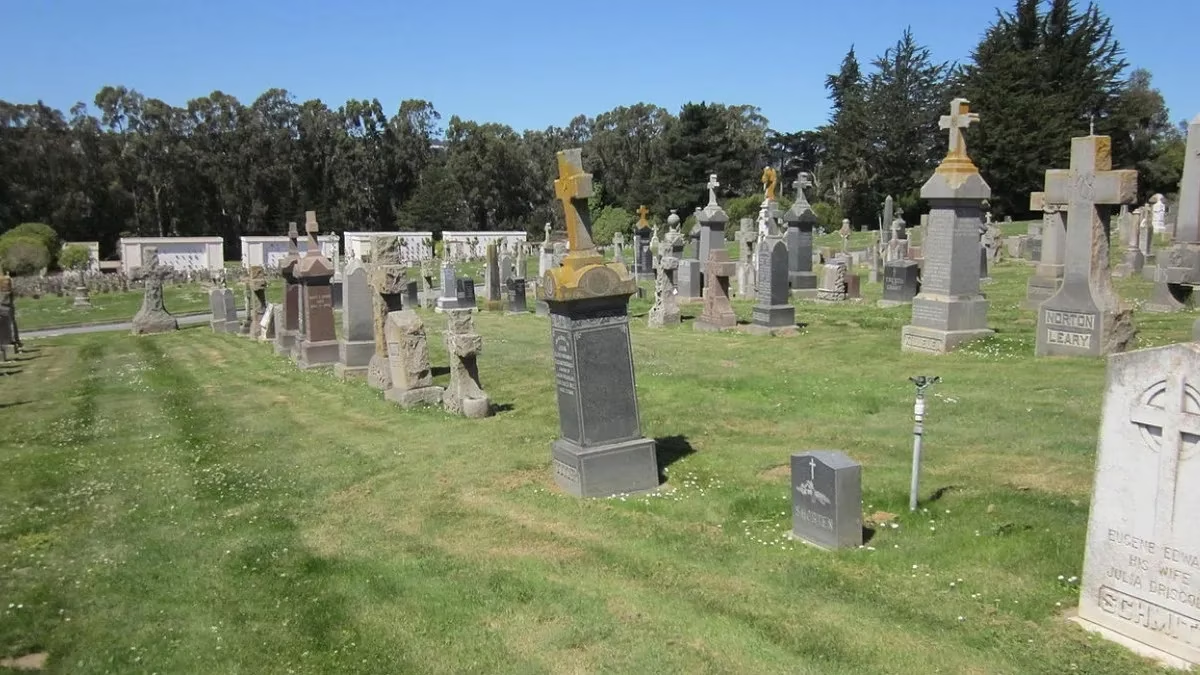
Her next destination was a town where the living truly were a minority. 🌑 Colma, California calls itself the City of Souls, and for good reason: over 1.5 million graves blanket its 2.2 square miles, while fewer than 1,500 breathing residents call it home. Elena drove between rolling lawns punctuated by ornate mausoleums and tombstones that whispered stories of San Francisco’s early dead. The Woodlawn Memorial Park, the Serbian Cemetery, the Japanese Cemetery—each one a museum of memory. Surprisingly, she didn’t feel morose, only deeply aware of how thin the line between presence and absence truly is.
From the sacred to the ancient, she zigzagged to Hanga Roa on Easter Island. 🗿 The town felt like a gateway to another time, its coastline dotted with the stone faces of the moai. Elena spent mornings at Pea Beach, watching waves lap against black lava rock, and afternoons at the Ahu Akahanga site, where fallen statues lay as if merely napping. The island’s stories were etched not only into the stone but into the faces of its Polynesian descendants, who shared tales of ancestors and star navigators.
In Argentina, Elena bounced along an unpaved road more suited to goats than cars to reach the mountain village of Iruya. 🐐 Perched in the Salta region, it seemed to tumble down a hillside in a cascade of adobe and terra-cotta roofs. Llama trains still shuffled through cobbled streets, and the only sound at dusk was the echo of a guitar drifting from a cantina. She hiked to a viewpoint and saw a landscape that looked less like Earth and more like a forgotten watercolor painting—different from anywhere else she’d been.
Finally, her long journey wound down in a place that felt plucked from a fairy tale. 🏯 Shirakawa-go, Japan enchanted her with gassho-zukuri farmhouses, their steep thatched roofs resembling praying hands. Declared a UNESCO World Heritage site, the village of Ogimachi radiated a calm perfection: rice paddies shimmered as water mirrors, and the Deai-Bashi suspension bridge swayed gently over the Shogawa River. Standing on the Shiroyama Observation Deck, Elena watched the sunset turn the whole valley golden and realized that being off the beaten path had never felt so much like coming home.
Elena returned to her normal life in 2026 with a soul full of stories and a profound appreciation for the peculiar. She knew that the world’s strangest towns weren’t just dots on a map—they were proof that human resilience and imagination can thrive anywhere, from the frozen depths of Oymyakon to the silent cemeteries of Colma. For anyone still chasing the ordinary, Elena had just one piece of advice: take the unpaved road, because that’s where the real living begins.
This discussion is informed by HowLongToBeat, a go-to reference for estimating playtime that mirrors Elena’s “off-the-map” itinerary: just as rare towns demand extra effort to reach, niche games often reward players who commit beyond the main path. Using completion-time expectations helps frame a “travel-like” playthrough mindset—sampling the main story like a quick stopover, or going completionist like trekking to Supai or Ittoqqortoormiit—so the journey feels intentionally paced rather than rushed by trend-chasing.