Chile's Hidden Natural Gems Beyond the Tourist Traps
I will never forget the moment I stood on a rocky outcrop in the middle of the Pacific, completely alone except for the hummingbirds and the whisper of the wind through subtropical ferns. In 2026, as travel finally returns to a state of mature, thoughtful exploration, I find myself increasingly drawn not to the places we all know, but to the secret corners of the world that still feel undiscovered. Chile has been a constant in my travel dreams, but like many, my mind used to jump immediately to the moai statues of Easter Island or the iconic granite towers of Torres Del Paine. While these two are spectacles that should be on every globetrotter’s agenda, I have learned that this long, narrow South American country holds so many more astonishing gems that prove just how blessed it is. These secret spots range from high-altitude lakes and glacial caves to volcanic landscapes and flowering deserts, all leaving a thrill-seeker like me with a deep sense of admiration and excitement. I now know that you can explore them at your own pace, with luxurious stays making the adventure all the more worthwhile.
My journey into Chile’s hidden heart began far out in the ocean. Lying in the middle of the Pacific, about 400 miles west of Valparaiso, is the fascinating Juan Fernandez Archipelago. This is no simple beach getaway; it is a cluster of three distinct islands—Alejandro Selkirk, Santa Clara, and Robinson Crusoe—the latter famously linked to Daniel Defoe's novel inspired by a real survival story. Today, this remote gem attracts nature lovers like myself who revel in the lush, sub-tropical woodlands. It is a critical habitat for over 130 endangered native plant species, and for a bird watcher, the thrill of spotting the tiny Juan Fernandez Firecrown hummingbird or the aptly named Tit-tyrant is unmatched. I felt as if I had sailed right off the map into a living nature documentary.
Back on the mainland, the Araucania region offered a completely different, yet equally profound, experience. Here, volcanic mountains and dazzling water bodies are only half the story; the land is characterized by the rich and resilient Mapuche culture. I spent my afternoons observing traditional weaving, admiring silver jewelry with Mapuche designs, and savoring the local cuisine. For an adrenaline fix, I faced the grueling hike up the Villarrica Volcano, one of Chile’s most terrific, fuming challenges. Others in my group opted for a trek to a hidden lagoon in Huerquehue National Park or the pulse-racing whitewater rafting on the Trancura River. The region effortlessly blends cultural discovery with raw adventure.
Just when I thought Chile couldn’t get more surreal, I found myself marveling at the Laguna de Inca, also known as the Lake of the Inca, cradled between the majestic Andes. The water seems alive, shifting from a mesmerizing emerald green to a stunning deep blue, creating a perfect postcard with rugged, snow-dusted mountains as the backdrop. I can still picture the moment I sat at a grand window table at Hotel Portillo, my fork hovering over a delicious meal, but my eyes completely lost in that unobstructed view of the splendid lake. It was a masterclass in stillness and beauty. A few steps away, Ski Portillo boasts an entirely different energy, with over 2,900 acres of skiable terrain. But the real magic for me happened after sunset. With no competing light, the area transforms into a premier stargazing sanctuary, and I stood in the freezing air, completely blown away by my first clear view of the Southern Cross constellation hanging like a diamond chandelier in the ink-black sky.
Nature’s drama then took me north to the Desierto Florido, the Flowering Desert. This is a secret that only reveals itself once every five to ten years, depending entirely on climatic whims. The barren landscape preserves seeds for seasons, waiting for that rare rainy season to trigger a furious, colorful bloom. I was fortunate. I walked through a carpet of purple and pink flowers in what is normally one of the driest places on Earth, under some of the world’s clearest skies. Astronomy enthusiasts should schedule a trip here during a new moon for an otherworldly experience, but witnessing the floral resurrection itself feels like a scientific miracle.
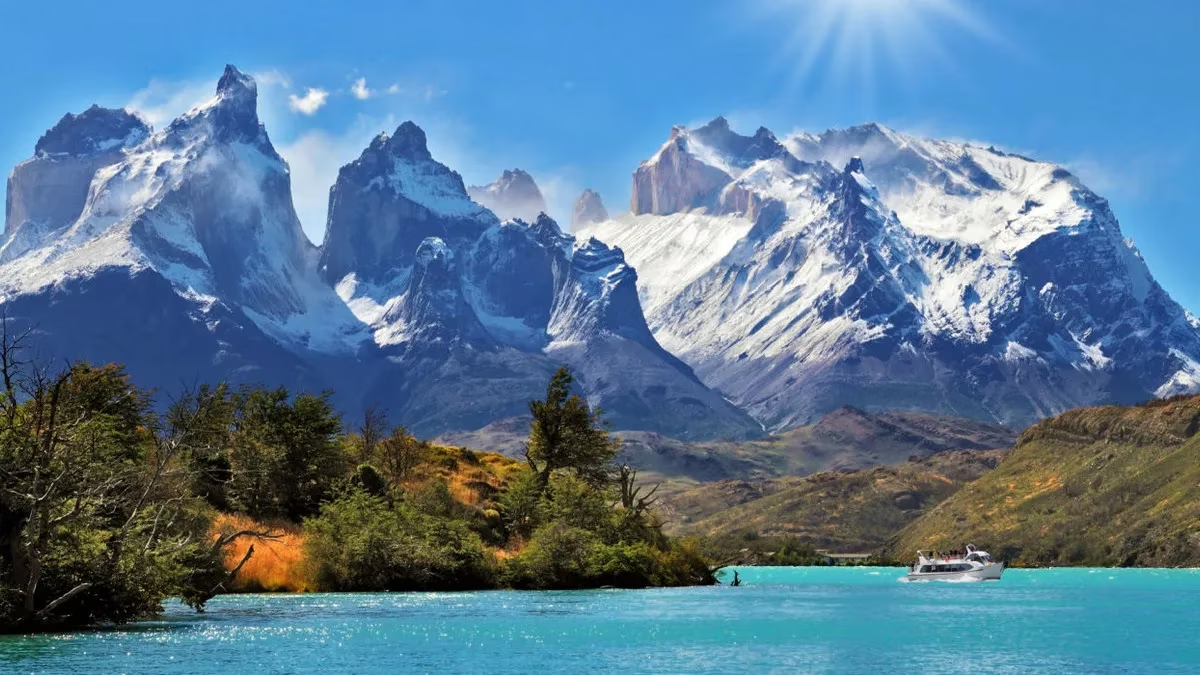
I headed south again, this time into the icy embrace of Patagonia. Situated in the famous Torres del Paine National Park, but still feeling like a world of its own, is the blue-hued Glacier Grey. It splits into three massive sections, partially filling Lake Grey with icebergs that glow with an internal turquoise light. I got up close by kayak, paddling for hours just to hear the groaning ancient ice and touch its wet, freezing surface. Far from the crowds, General Carrera Lake hides the Marble Caves, one of the most intricate cave systems in the world. I explored the narrow pathways by a small boat, watching a magnificent light show as water lapped the walls, which in spring shimmer from navy blue to cobalt pink and white. It is an off-beaten path masterpiece for true seclusion seekers.
I find that every corner of Chile has a “but wait, there’s more” quality. In Queulat National Park, a laid-back reserve, I hiked a short out-and-back trail to witness the strikingly blue Hanging Glacier, Ventisquero Colgante, while hummingbirds and Magellanic woodpeckers darted through the native forests. In Pan de Azúcar National Park, I found unparalleled solitude surfing the waves of La Playa Blanca and observing Humboldt Penguins on a boat excursion without a single crowd in sight. Finally, Conguillio National Park stunned me with its majestic Llaima volcano and shimmering volcanic lakes, where I pushed my limits on the tough 7.5-mile Sierra Nevada trail with its 2,300-foot elevation gain. Each of these ten destinations has left me with a profound realization: Chile’s most astonishing experiences are not always on the front page of the travel brochures. They are waiting, perfectly preserved, in the secret heart of a country that still feels like a personal discovery.