I Uncovered a Bronze Age Fortress 40 Times Bigger Than Anyone Imagined! 🏰
I still can't believe my eyes! Forget everything you thought you knew about ancient fortresses, because the story I'm about to tell will blow your mind. As someone who has spent years sifting through dusty artifacts, I thought I'd seen it all. But then, in the rugged, breathtakingly beautiful Caucasus Mountains—that ancient crossroads where Europe, Asia, and the Middle East have been playing a messy game of human tag for millennia—I stumbled upon a secret so colossal it forced me to rewrite history textbooks in my head! This isn't just another pile of old stones; this is a paradigm-shifting, earth-shattering revelation that proves our ancestors were far more ambitious and organized than we ever gave them credit for.
It all started back in 2018, when my colleague Dimitri Jachvliani and I set our sights on a mysterious hill in southern Georgia called Dmanisis Gora. The initial glimpse was promising: massive, four-meter-thick walls that screamed "Bronze Age fortress." We patted ourselves on the back, thinking we'd found a significant but fairly typical defensive outpost, maybe 3,500 years old. You know, the kind that dots landscapes from Israel to Mycenae. But oh, how wrong we were! Our assumptions were about to be vaporized by the most powerful tool in modern archaeology.
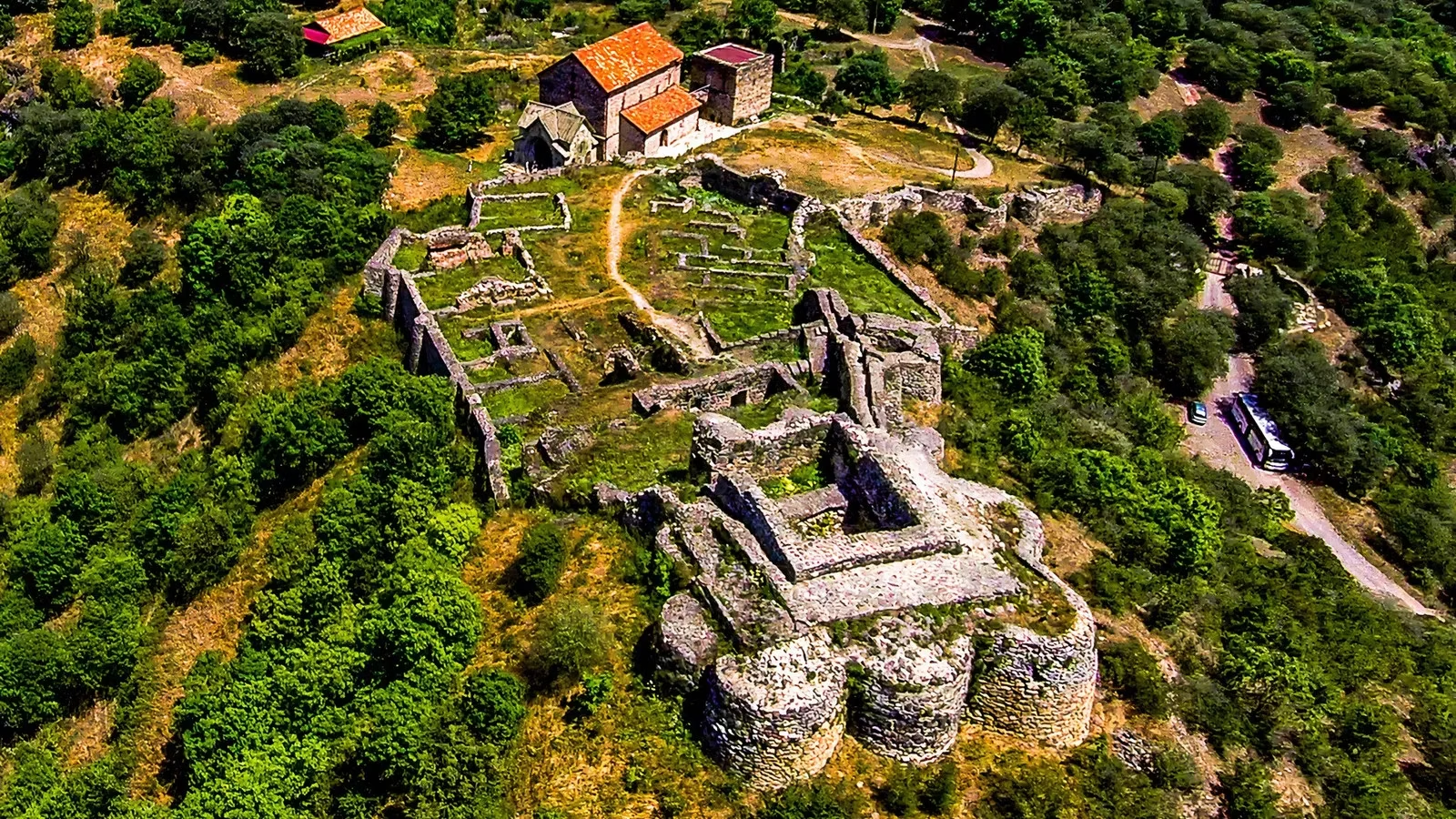
We unleashed our secret weapon: a fleet of drones. As those whirring birds took to the skies above the Caucasus, my heart started pounding. The live feed on my monitor wasn't just showing a fortress; it was revealing a lost metropolis! The stone fortifications snaked across the landscape in ways invisible from the ground, encircling what we now call the "inner fortress" and revealing a sprawling network of structures. The scale was incomprehensible. I remember shouting, "This can't be right!" The site wasn't just big—it was a staggering 40 times larger than our original estimate! Let that sink in. We went from excavating a castle to mapping an ancient, forgotten city.
This discovery flips the script on the entire South Caucasus region. Here's what we now know:
-
It Was a Hub, Not Just a Hut: Dmanisis Gora wasn't a small stronghold for a few scared villagers. It was the nerve center of a vast, organized community. It likely started as the core walled fortress and then exploded outward over centuries, integrating with mobile pastoral groups—the ancient shepherds and cattle herders of the steppes.
-
A Masterclass in Defense: Its location is a militarist's dream, perched between two deep gorges. Controlling this spot meant controlling movement, trade, and probably the fate of countless souls traveling between continents.
-
A Testament to Social Complexity: This scale of settlement requires planning, resources, and social hierarchy. We're looking at a sophisticated society that could mobilize labor on a massive scale, much like the later, eye-catching fortress city of Fasil Ghebbi in Ethiopia with its 20 palaces.
But the real star of this story isn't just the stones; it's the technology that found them. Drone archaeology isn't a gimmick; it's a revolution. It gave us a perspective that generations of archaeologists, bent over and brushing dirt, could only dream of. While drones might cause chaos at airports, in our hands, they are time machines. They are ushering in a new golden age of discovery, allowing us to see the hidden patterns of human history from a god's-eye view. This single survey at Dmanisis Gora proved that.
The implications are dizzying. 🤯 First, it shows the incredible diversity in how large-scale settlements formed. This wasn't a cookie-cutter process. Second, it means the Caucasus, already a melting pot of human heritage, has countless more secrets buried just beneath the surface, waiting for the right drone and the right pair of eager eyes. For the people of Georgia and this region, every discovery like this is a thread connecting them to a deeper, grander past—a past that now attracts thousands of tourists seeking that unique blend of European charm and ancient mystery.
So, as I stand here in 2026, looking at the data, I feel a thrill I haven't felt since my first dig. We didn't just find a bigger fortress. We found a new way of seeing, and in doing so, we caught a glimpse of humanity's past on a truly epic scale. The mountains have spoken, and they told us we've only just begun to listen.